
Collecting
The real reason you bought it
Most first original paintings are not chosen under decorator influence. They are chosen under memory, a kitchen window in late afternoon, a room a collector half remembers from a childhood that no longer exists. A note on why the language usually arrives two weeks after the work hangs.
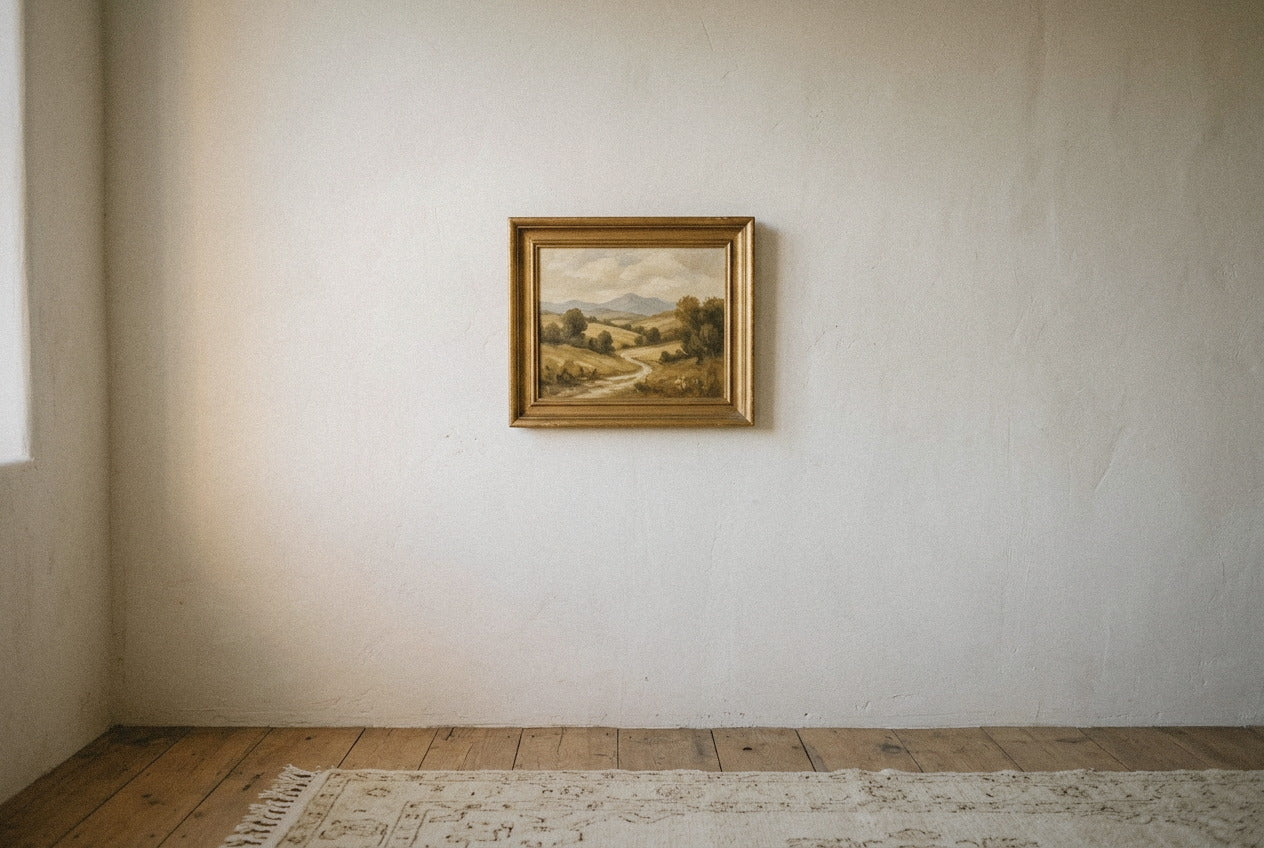
It was Wednesday in the atelier, the late May light slanting low across the floorboards in that thin, almost reluctant way it does before the season tips into June. An email had been open on the laptop for an hour. A collector in Boston, three months after the painting arrived, finally telling me what she thought she had bought.
The decorator script no one followed
If you read the buying advice that circulates in interior magazines and on Pinterest, you would assume that people who acquire their first original painting begin with a list. Wall dimensions. A palette to match existing furniture. A balance of scale and tone. A vague nod to the rule of three. The list is real. A few collectors do walk that path with a measuring tape and a swatch book.
Most do not. Most of the first originals I send out leave the atelier because a person stopped scrolling and stayed on one image for a length of time that surprised them. They came back to it that night. They came back the next morning. Eventually they wrote in. The decorator script is something they read later, often a week after the work has arrived, in an effort to explain to themselves what just happened.
What was actually deciding
The collector in Boston had bought the work in February. A small landscape, low horizon, late afternoon light slipping across a field. She had told her partner the painting matched the cream rug in the family room. Three months in, she wrote back to me. The matching, it turned out, was not about the rug. It was about a kitchen window in her grandmother's house in upstate New York, where on certain Sunday afternoons in October the same yellow had spilled across linoleum while a kettle ticked. She had been six. The room was now gone, sold to strangers in 1997. The painting, she said, had brought it back to her without her permission.

I have heard versions of this story enough times now to stop treating it as coincidence. The hallway in a parents' apartment that smelled of iron and vinegar. The ochre wall of a stairwell on a college trip to Lisbon. A particular ratio of yellow to gray in a friend's first apartment, the one where you stayed up too late on a Tuesday in 2003. The collector almost never has the language ready at purchase. The language arrives later, in a quiet room, often around the second week.
Most first paintings are not bought under decorator influence. They are bought under memory, and memory is rarely consulted at the moment of clicking.
Why this matters in the studio
I cannot deliberately paint your grandmother's kitchen. No painter can. What I can do, and what I think the work that travels from this studio of originals is actually doing, is paint specific light and specific weather. A particular cast of yellow at four in the afternoon. The blue that arrives in a room ten minutes after the sun has dropped behind the next building. A green that is only a green because there is a thin gray beside it. These are not abstractions. They are documents of hours.
When a piece carries that kind of specific time, it becomes a kind of receiver. It is waiting for a room in someone's past to recognize itself. The painting I think will not sell, the quiet one, the one I almost hold back because it seems too thin to compete with louder works on the page, is often the one that lands the hardest. It was, in fact, true for the painting she almost sent back, which arrived in a room that, weeks later, the collector realized was almost identical in proportion to a room she had not stepped into for thirty-one years.
The two-week lag
If you have acquired a first original in the last six months and felt slightly confused about why, you are probably in the lag. Two weeks is the average. Sometimes a month. Sometimes the realization arrives at four in the morning, when the painting is the only thing visible from the doorway and the room has cooled and the light is wrong on purpose. It is not unusual for a collector to write me about a piece long after I had assumed the transaction was finished, the way other works seem to keep speaking long after they have left.
What I want to say to anyone in the middle of that lag is simple. Do not rush to explain it to yourself. The decorator language will come back, and it will be fine. The room will still be matched. But the matching was, almost always, the cover story. Underneath was something older. It is not the painting you chose. It is the room you remember.
Share this story
Continue reading

