
Studio
The paintings that never leave
For every painting that leaves the Brooklyn atelier, two or three never do. They stack face to the wall in a corner I do not photograph, roughly seventeen deep right now. A note on the pile, and on why the ones that survive depend on the ones that did not.
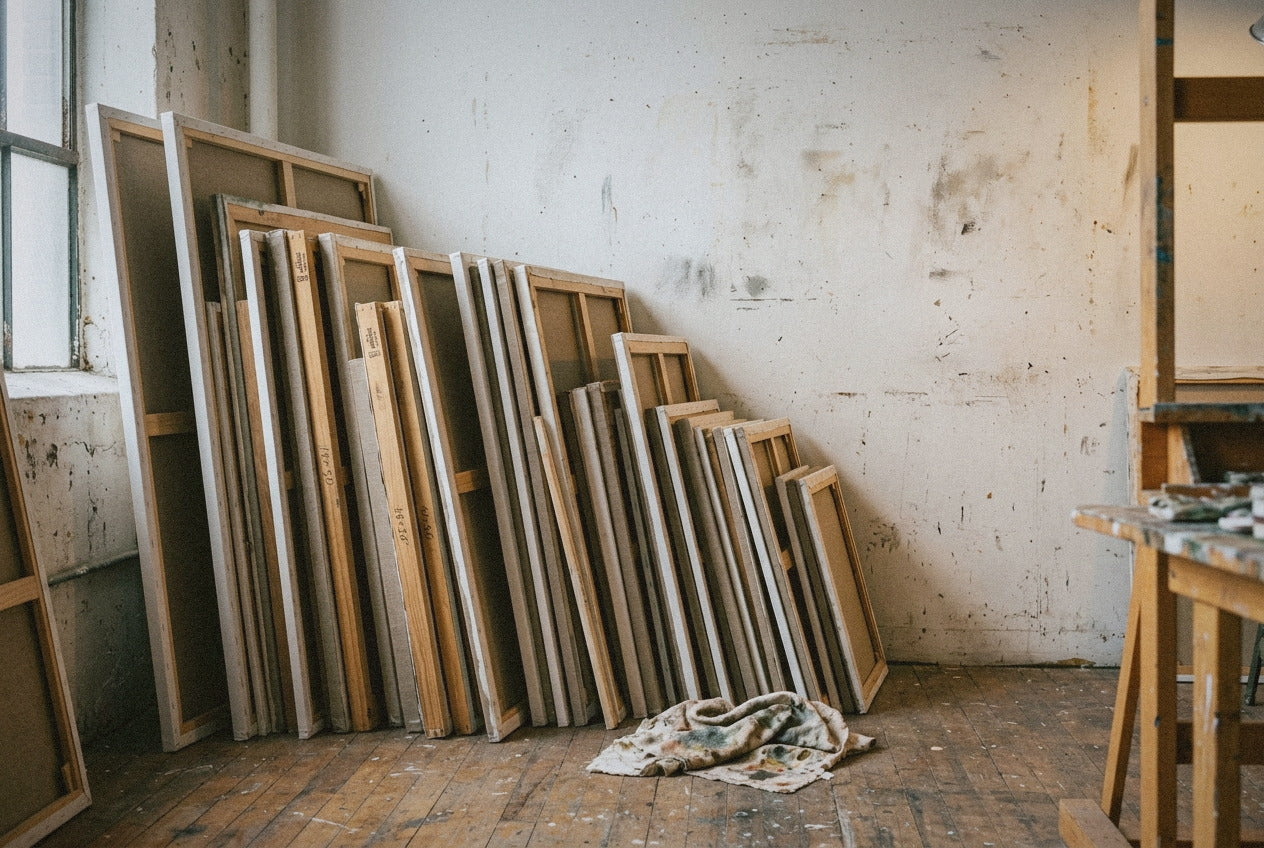
It was a Friday afternoon in the atelier, the May light long enough now to reach the back wall where I keep the pile, and I had pulled one of the canvases out to look at it again. The corner smelled of stretchers and old turpentine, the underside of work that never sees a buyer. I had not touched that one in eleven months.
The corner I do not photograph
There is a place in the studio where canvases stack face to the wall. Seventeen of them right now, give or take. I count them once a season the way you might count cordwood, not with any plan to use them, just to know what is there. Most are large. A few are small. All of them were once worth a stretcher and a primer and a week of light.
A visitor once asked if she could see what was in the pile. I told her no. Not because of vanity, though there is some of that. Because the pile is not finished work, and not unfinished work, and not work in progress. It is a different category. It is the residue of decisions a hand makes when it cannot do two things at once.
Why a hand makes a pile
Every original I send out depends on canvases I never send out. A piece is a series of small refusals stacked on a single surface. This blue, not that one. This edge, not the one underneath. Two days into a painting I might know it is going the wrong way, and I have to choose. Continue and learn what is breaking, or turn it to the wall and start the one that is asking to be made. Either way, the pile grows.

A factory does not have this corner. A printer does not have this corner. Software that generates an image does not throw anything away, it simply tries again, in a different folder, with no smell. The pile is not a poetic flourish. It is the physical evidence of a working day that included a wrong turn and a person who had to stop.
I do not enjoy the pile. In honest moments I have wanted to set fire to the whole corner. I have not. The reason is below.
The discarded canvases are not failures. They are the reason the kept ones hold.
What they teach the ones that leave
A piece that left the atelier last March was not a piece I made in March. It was a piece I made because of three canvases I gave up on in January. One of them had taught me how a certain green refuses to sit next to a certain ochre. Another had taught me that the gesture I was reaching for needed half the paint I was using. By the time I started the March piece, the wrong moves had already been made on other surfaces.
You can read this and think, that is just practice. It is not just practice. Practice is repetition with the same intent. The pile is the opposite. Every canvas in it had its own ambition, its own scale, its own season. There is a 2024 attempt at the kind of light I finally got right last autumn. There is a 2023 abstract that I now look at and recognize as a sketch for a current piece in the originals on the site. The pile is not a teacher in the formal sense. It is a record of every conversation I had with the work that did not go to a collector.
I have written before about the year I stopped counting canvases, and about six weeks on the wrong canvas. Those pieces are about persistence. This one is about its quieter twin. The decision not to persist. Both are part of how a working studio stays honest.
The pile is not waiting to be solved
Most things in a studio get fixed. The pile does not. A canvas in the pile is not waiting for me to come back and rescue it. Some I will never look at again. A few I might pull out in five years and discover that what looked like failure was an idea I was not ready for.
The Friday I pulled the canvas out, I had no plan for it. I looked at it for maybe ten minutes. There was a stretch of blue I had clearly been wrestling with, two different attempts visible under the top layer. I put it back, face to the wall, with the others. Tonight it goes back into the corner, faced inward, until it is ready or it never is.
Share this story
Continue reading

