
Studio
The paintings that survive year two
A collection of letters from collectors in the second year reveals a pattern: the paintings chosen quickly, for mood and color, often find their way back to the atelier. The ones that stay are rarely the boldest or the most immediately striking. They are the paintings that needed a season to settle, that became more themselves as the light in the room changed.
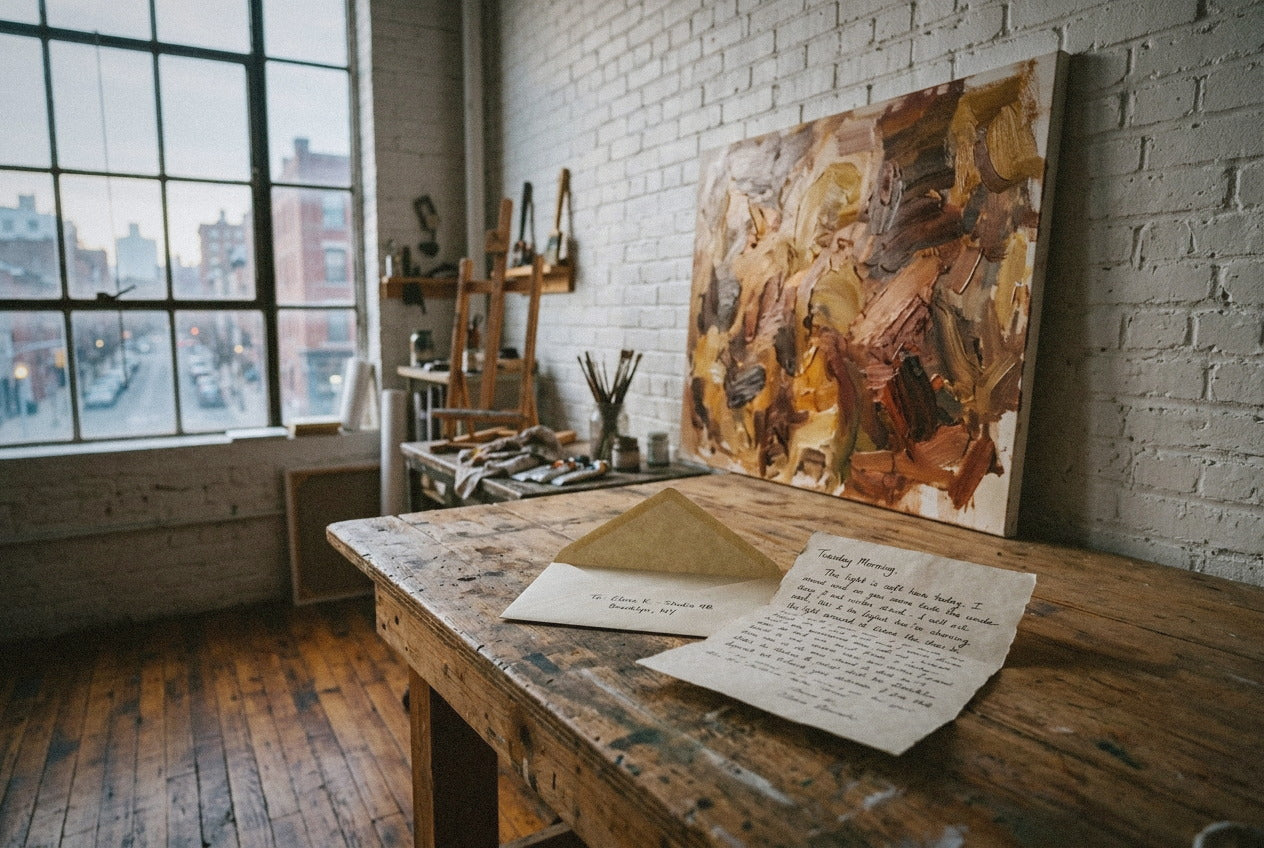
It was a Thursday morning in the atelier, early June, the east window already past its useful hour. A letter had come in by email, the kind that takes a few readings to fully land. A collector I had sold to eighteen months earlier was writing to say that the piece had become something different from what she had bought. Not better, not worse. Just different, and more her own.
The Ones That Come Back First
There is a pattern in the pieces that get returned, and I have watched it long enough now to be unsurprised by it. The returns are rarely the difficult paintings, the ones that took three conversations and a photograph-in-context before someone committed. Those tend to stay. The returns come from the certain choices, the immediate ones.
A collector walks into the atelier or opens the site on a Saturday morning, and something lands in under sixty seconds. The color is exactly right. The scale feels obvious. There is nothing to argue with. Six to fourteen months later, it is back.
The pattern shows up most clearly with smaller canvases, the size that feels like a reasonable first decision. Safe in price, easy to place, uncomplicated to live with. They are the pieces that come back most often. Not because they failed, but because they were bought to succeed on the first day.
I do not say this to discourage quick decisions. I say it because the certainty itself is sometimes the thing to watch. A painting that answers every question immediately may be answering the question of the room you have right now, not the one you are becoming.
What a Season Does to a Painting
The longer I have watched pieces leave and come back, the more convinced I am that a room is a living thing that changes faster than anyone plans for. A different job, a new sofa, one wall repainted in winter, and a painting that was perfect in October starts asking to be elsewhere.
What does not survive is usually not the difficult piece but the agreeable one. The painting that coordinated perfectly with the new rug. The one that matched the curtains, as several collectors have told me, and then the curtains changed. Color compatibility is not the same as compatibility.
The pieces that survive this are the ones that had some resistance in them. A texture that was almost too much in the first week. A palette that took three months to feel fully settled. These are the ones collectors write back about, not to complain, but because something has shifted and they want to say so.
An original painting with heavy impasto and a palette built on earth tones does something particular with time. The oil oxidizes over the first twelve months in a way that deepens the ochres and warms the shadows. It becomes more itself.

The pieces that survive are the ones that had some resistance in them at the start. A palette that took three months to settle. A scale that felt like a commitment.
The Shift That Happens in Year Two
What drives the first decision is almost never what determines whether a painting stays. The initial conversation is about color, scale, the mood of the room. The second conversation, the one that happens eighteen months later by letter or phone, is about something harder to name.
The collector who wrote that Thursday had bought a 24x30 canvas in ochre and sienna. At the time she described it as safe, but in the best way. Eighteen months later she was telling me it had stopped being safe and started being necessary.
That word landed differently than she probably intended. Necessary. Not beautiful. Not striking. The painting had moved from being a thing she had chosen to a thing she could not imagine not having.
The collector's relationship with a painting is not static, and that is the part the industry rarely talks about. A gallery shows you a piece under careful lighting with nothing else competing for your attention. The real test is a Tuesday in February when you are running late and you pass the painting on the way to the door and it does something to the morning. Or does not.
I have had similar notes from collectors who, in the first weeks, were certain they had made a slightly too-cautious decision. They wanted more edge, more color, more statement. By month fourteen, the painting they had second-guessed had become the anchor. I keep notes from these conversations alongside photographs of the pieces that stayed in the atelier too long, waiting for the room that could hold them.
I keep the letters. Not as testimonials, not as marketing. As a record of what happens to a painting after it leaves. There are about forty of them now, spread across two years, from collectors in Chicago, Seattle, a few in London. Most of them were written not to say that the painting was beautiful, but to say that it had become hard to describe.
That is the thing I keep coming back to. By year two, the paintings that stay are almost never described. They are just there.
I keep the letters. They say more about the room than about the painting.
Share this story
Continue reading

