
Process
Why I never paint in batches
The first time a collector asked why I do not paint in batches, I almost did not understand the question. Notes from a Brooklyn atelier on why a print logic ruins original paintings, what the eye actually sees in batched work, and what three days of doing nothing does to a finished canvas.
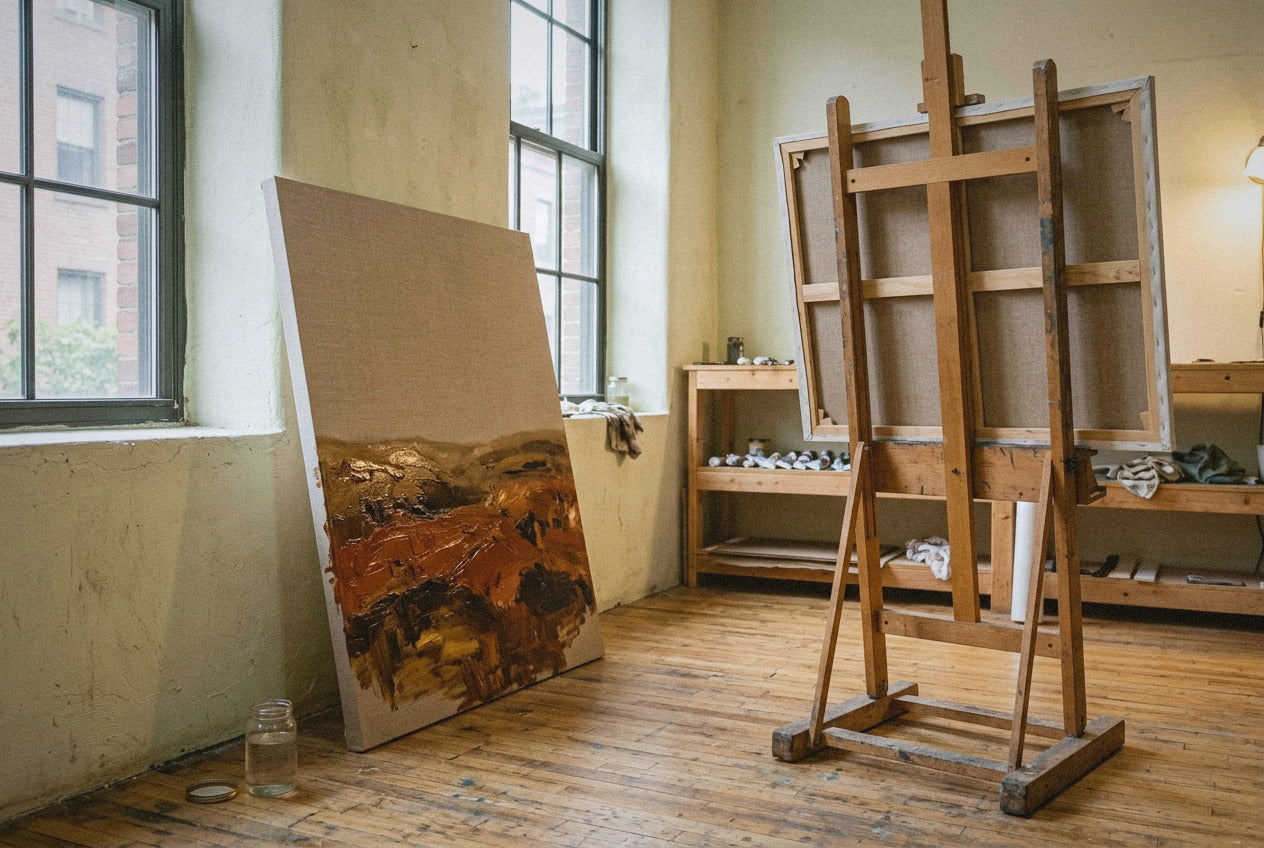
The painting I finished yesterday is leaning against the north wall, oil still tacky on the lower third where burnt sienna pooled into the weave. On the easel a raw canvas is turned to face the wall. It will stay that way for three days, long enough for me to forget what I just did.
Batching is a print logic
The first time a collector asked, in a comment under a process clip, why I do not paint in batches, I almost did not understand the question. It came from a workflow vocabulary that belongs to printers, kitchens, and content studios, not to a single hand in a single room. To paint in batches you have to decide, in advance, that the next painting is going to be a version of the last one with the variables changed. That is exactly what I have spent the last fifteen years trying not to do.
There is a marketplace logic that flatters batching. Faster turnover. Predictable supply. A flatter learning curve for a hand that gets to repeat itself. Painters who switch to batches usually start because someone asked for the same one but slightly different, and that single yes ages a hand the way ten unrelated commissions cannot. The hand stops finding the painting and starts repeating it.
What the eye sees in a painting made in a row
The reason this matters is not romantic. It is visible.
When a painter works five canvases at the same time, the wrist defaults to its strongest move. The eye stops correcting because it has stopped surprising itself. By the third canvas the brushload is muscle memory, by the fourth the colour decisions are an algorithm of what worked last time. The piece still looks made by a person. It does not, however, look made by a person who was paying attention to this particular painting.
I have stood in front of those works. The give-away is usually in the negative spaces. A passage of unpainted ground reads the same in all four pieces, the same width of left-out gesso, the same intuitive grip of the brush at the same downward angle. The hand was talking to itself, not to the canvas.

Batching is efficient for prints. It is poison for originals. The hand stops finding the painting and starts repeating it.
What three days of doing nothing does
The other reason I work this way is the gap. Between finishing one piece and beginning the next, I leave at least three days where no new canvas is started. The finished work goes against the north wall where the morning light is consistent and ungenerous. I walk past it on the way to the kettle, on the way back from the post office. After a day, the parts I was proud of go quieter. After two, the part I was not sure about either fails or finally lands. By the third day I know the painting. Not in the way I knew it at the easel, but closer to the way a collector will know it on a wall at home, in a passing glance from the hallway.
This is the part of the process a batch makes impossible. When the next canvas is already wet across the room, there is no walking past. The hand cannot afford to look at yesterday's work because today's is asking for something. I have written before about how a piece can take six weeks because it was simply the wrong canvas to begin with. That decision is only available if I have not already started three more of them.
The one canvas in the room
There is usually only one painting at a time in the active rotation of this studio. The other surfaces in the room are turned away, leaned, stacked. A new linen is not stretched until the last has dried enough to be wrapped or hung. Visitors find this strange. They expect a studio to look like a feed of paint tubes and a wall of works in progress. The atelier of one canvas at a time looks emptier and quieter than they imagined, which is also part of the point.
It is also why I have stopped keeping a yearly count. The number of originals a single hand can honestly finish in a year is far smaller than the marketplace suggests it should be, and most of the work of being a painter is making peace with that. A year of refusing to measure the studio in numbers is what taught me to keep the easel empty between paintings rather than full.
The raw canvas on the easel will not be turned around until Thursday. I do not yet know what it is going to be. That is the only honest answer to the question of how many paintings can come out of a room with one hand in it.
Share this story
Continue reading

