
Interiors
Why hallways are the honest gallery
A homeowner in Connecticut sent photographs of seven walls in her house, asking which was right for a painting she was considering. By the third exchange the hallway was the clear answer, and it almost always is. A note on why a hallway is the most honest gallery in a house, and what changes in a commission when the wall is narrow and the light is warm.
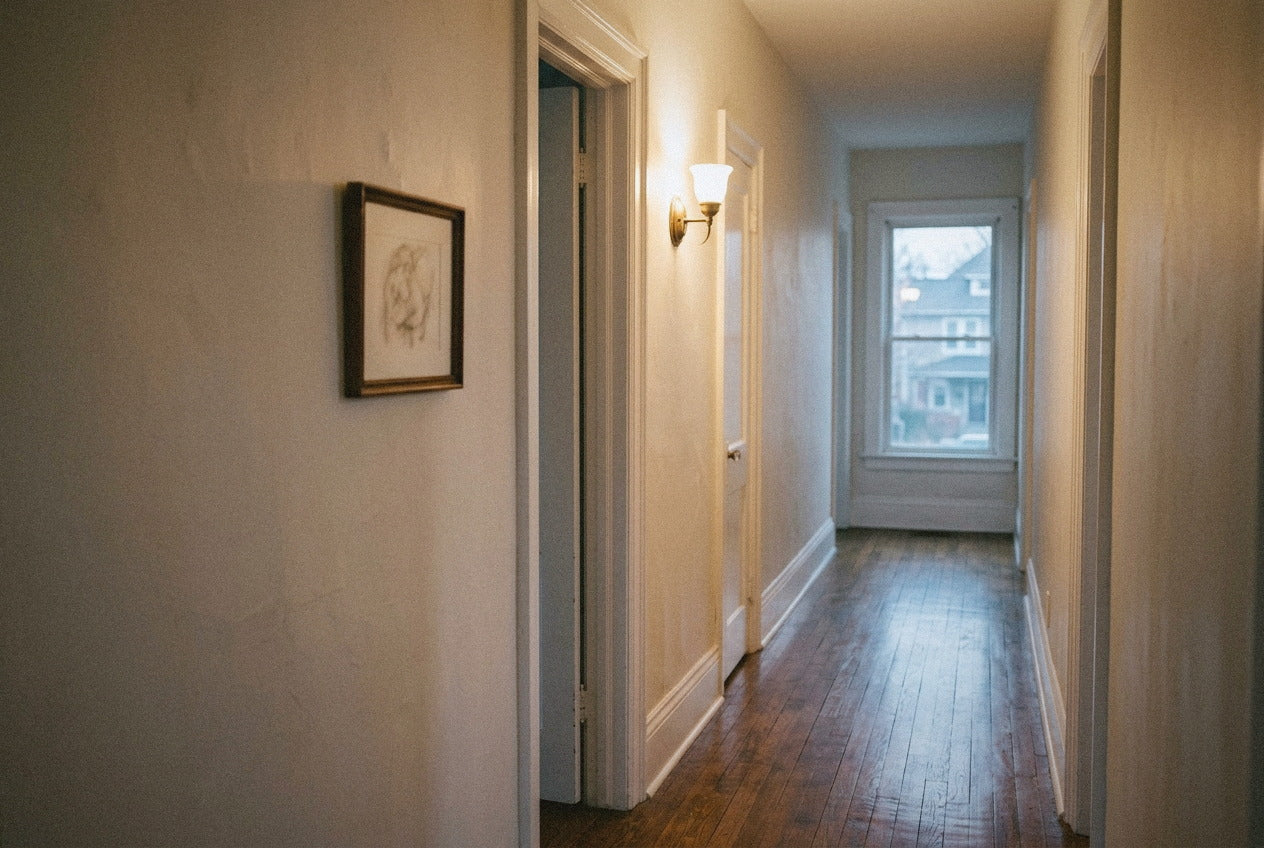
A homeowner in Connecticut sent me photographs of seven walls in her house over the course of January, asking which would be the right one for the painting she was considering. The walls were a living room, a dining room, two bedrooms, an office, and two hallways. By the third exchange, I had stopped looking at the living room. The hallway was the right one.
The living room and the quiet lie it tells
Living rooms are the rooms that get decorated for guests. The sofa is positioned for conversation, the rug is sized for the imagined friends, the art above the mantel is chosen with a dinner party in mind. None of this is wrong, but it does mean that the art in a living room is carrying a social job as well as an aesthetic one. It has to be appropriate. It has to be interpretable. It has to hold the room when there are twelve people in it, which is the condition the living room was designed for.
Hallways are the rooms that are never decorated for guests, because no guest stands in a hallway. A hallway is a transit space, and the art on its walls carries no social job. It only has to hold the wall for the one person who walks past it, twice a day, for thirty years. That is a very different requirement.
Why hallways do not bother to pretend
When I look at a hallway photograph from a homeowner, I know more about her taste than I would from six photographs of a living room. The art in the hallway was chosen without an audience. It is the art she wants to see on her way to bed, on her way to the kitchen at six in the morning, on her way to the door when she is leaving for the day. It is not chosen to impress. It is chosen to live with.
A hallway will tell you what a homeowner actually believes. A small graphite drawing on foxed paper that has been there for twenty years. A framed photograph from a trip she took before her children were born. A very small oil painting, fifteen by twenty centimeters, that she bought from the atelier two years ago and which, she will tell you if you ask, she looks at more often than anything else in the house. These are the honest pieces. They are also, almost always, pieces with a provenance that begins with the homeowner herself, not with three previous walls.
The living room holds what you want your guests to see. The hallway holds what you want to see.
The scale and the light
A hallway commission is technically different from a living room commission in two ways that matter. The first is scale. A hallway narrows the viewer's distance. You never stand four meters from a hallway painting; you stand one and a half, or less. The painting does not need to read across a room. It needs to reward close inspection, which means the brushwork can be finer, the passages smaller, the color more restrained. A painting that works at two meters often fails at one meter, and vice versa. I adjust for this from the first sketch.
The second is light. Hallways almost never have a window. The painting will be lit by whatever fixture the house has installed, which is usually warmer in color than the north light in which the painting was made. I compensate for this by shifting the painting's cool passages one step cooler during the final glaze, so the hallway's warm tungsten does not pull the whole painting into a single temperature. It is a detail the homeowner will not consciously notice. She will only notice that the painting feels right in her hallway at ten at night, and does not feel as right in someone else's living room at noon.
The small art that quietly outlasts the big art
The Connecticut homeowner chose the smaller of the two paintings she had been considering, and hung it in her upstairs hallway, between a child's bedroom and hers, where she passes it at least eight times a day. She told me, on a phone call in March, that the larger painting in the living room, which she had also kept, was admired by her guests and walked past by her.
The hallway painting is the one she stops at. It takes her about four seconds, each time. Over thirty years, that adds up to about ninety hours of looking, which is more attention than any painting in any living room has ever received. That is the real gallery. It is a stretch of six meters of drywall between two doors, lit by one warm fixture, and it is the most honest room in the house.
Share this story
Continue reading

