
Interiors
The wall you promised yourself
Every home has one wall that has been waiting on a decision for two years. On the fifteenth of January, after the house has properly emptied out, the decision becomes easier. A note from the atelier on the quiet month when returning clients finally make up their minds, and why the painting alone is usually the whole refresh.
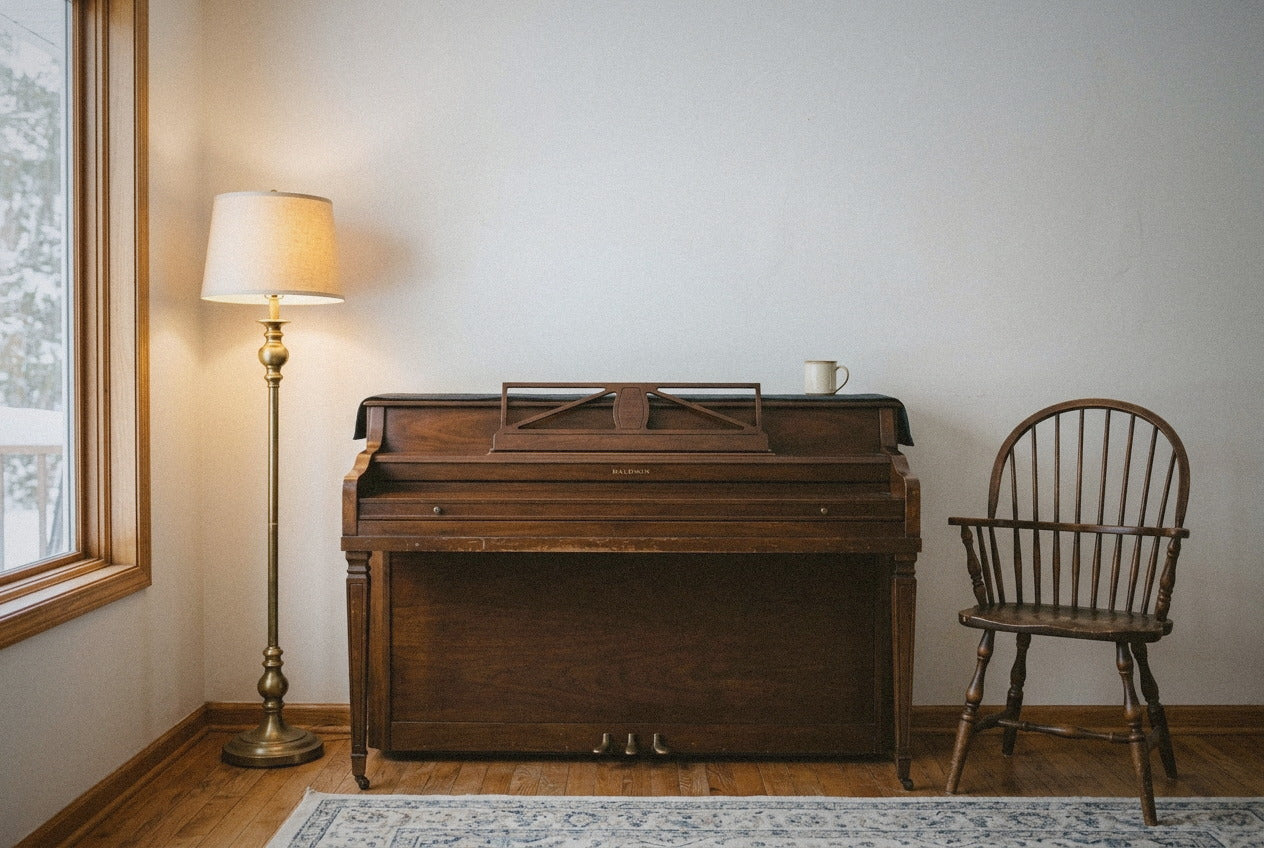
A collector from Chicago wrote to me on the fourteenth of January at five in the morning. The wall behind her piano had been empty since two Christmases ago. She was not writing to order. She was writing to ask if it was normal to have stared at the same wall for seven hundred nights.
The wall that waits
Every home has one. The wall that you walked past in 2024 and said, out loud or to yourself, that you would do something about it this year. You did not. By late October the list had become a different list, about the holidays and the people staying over and the table needing one more leaf. The wall was still there in December, now a little more ignored than before, because it had been given two full years of your noticing and still held nothing.
I have seen this exact wall in Denver, in Westchester, in a townhouse outside Seattle. It is almost never a main wall. It is a wall in a reading corner, above a stair landing, in a hallway between bedrooms. The kind of wall a stranger does not register on first visit, and that you see every single day.
Why January is different
For the recipient who has been waiting on a decision, January is the first honest month. The tree is down on the fifth or the sixth. Epiphany clears the last of the greenery. The children, if they came, have gone back. The house is finally yours again, and the quiet is the kind of quiet in which a wall can be looked at properly, without the competing story of a centerpiece or a garland or a folded visitor bed.
Between the fifteenth and the twenty-fifth of January, the atelier sees more orders from returning clients than in any other ten-day stretch of the year. I did not design this pattern. It simply happens, because a decision that would have been heavy on the twelfth of December becomes very light on the seventeenth of January, once the house has properly emptied out.
The house does not go back to normal on the second of January. It goes back to normal somewhere around the fifteenth.
The order that arrives without a rush
A collector who has waited two years does not need the painting to arrive in fifteen days. That is the surprise. When I began the atelier I assumed the long-waiters would be the most impatient. They are not. They have done their waiting already, silently, through two holiday seasons. A few more weeks, while I work, does not feel long to them. They have mentally moved in already.
What they want, almost always, is a conversation about scale. The wall has been empty for so long that any size begins to feel plausible. I ask for a phone photograph with a chair in the frame, for ground truth. More than half the time, the scale they were considering is too small. Empty walls read larger in memory than on camera.
From the originals bench, I send back a sketch on paper with the proposed dimensions taped to the wall image. It is an unglamorous step. It is also the step that prevents the second wave of hesitation, the one that arrives in week four when the collector wonders whether the painting will disappear on a wall that has been reading as enormous for two years. Nothing else in the room needs to change. That is the actual question behind the two years of waiting, and almost always the answer is that the painting alone is the refresh. The rest stays.
The third Christmas
The Chicago collector and I worked through a commission that month. It was finished in March and shipped in April. She sent me a photograph in May, from the piano corner, taken at the same early hour she had first written. The wall no longer looked like the wall that had been waiting. It looked like a wall that had always been this way.
By the time the third Christmas came around, she did not mention it to me. I took that as the right kind of silence. The wall had stopped being a question. That is the point of the exercise, and it is why January, not December, is the quiet month in which the old rooms finally get their last corner finished. If there is a wall in your house that has been waiting, the fifteenth is a good day to begin the conversation with it.
Share this story
Continue reading

